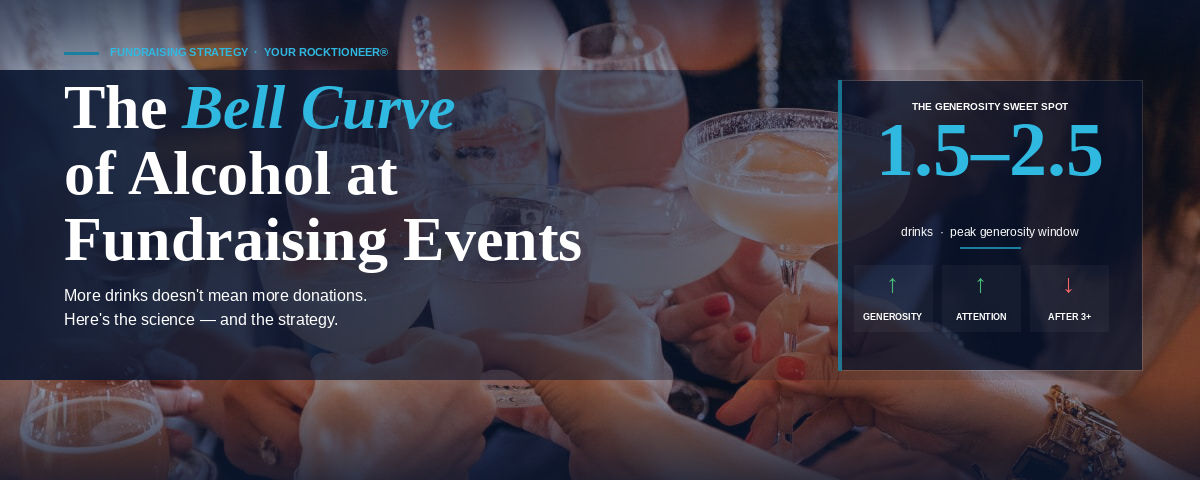
The Bell Curve of Alcohol
at Fundraising Events
More drinks doesn't mean more donations. Here's the science — and the strategy — every nonprofit event planner needs to know.
"You'd think more drinks means more donations. Science says otherwise. There's a bell curve — and if you don't understand it, you're leaving real money on the table."
Enough to feel warm and social. Not enough to impair judgment. This is your fundraising window — and it closes faster than you think.
Why a Little Alcohol Actually Helps
Research on alcohol and prosocial behavior shows that low-to-moderate drinking creates the conditions for generosity to flourish. This isn't a hunch — it's behavioral economics in action at your gala.
- Lowers social inhibition People become more willing to raise their paddle, approach the Fund-A-Need, or make a spontaneous bid they might have second-guessed sober.
- Increases generosity Mild disinhibition reduces the psychological friction of parting with money. "Liquid courage" is real — and it benefits your mission.
- Amplifies emotional connection Alcohol enhances emotional responses, which means your mission storytelling hits harder on the ascending curve. Your Fund-A-Need moment lands deeper.
- Boosts social bonding Guests feel more connected to the room and the cause — reinforcing peer-pressure giving. When their tablemates raise paddles, they follow.
When the Room Turns Against You
Past the sweet spot, the same alcohol that loosened wallets starts closing them — and creating problems you'll be dealing with long after the event ends.
- Attention span collapses You lose them during your FAN story or lot description. An auctioneer working a distracted room is fighting uphill. If they're not listening, they're not giving.
- Bidding becomes erratic You get either reckless overbidding (leading to buyer's remorse and failed collections) or people who check out entirely. Neither is good for your totals.
- The room gets loud and disruptive Noise drowns out your auctioneer, your mission moment, and your momentum. Energy shifts from generosity to chaos.
- Complex giving decisions break down Tiered Fund-A-Need levels, multi-lot packages, matching challenges — these require cognitive engagement. Intoxication makes that processing harder.
- Post-event regret and non-payment The dreaded "I don't remember bidding that much" conversation. Failed collections hurt your net and your donor relationships.
Timing Is Everything
Experienced benefit auctioneers don't leave alcohol management to chance. Here's the event flow that keeps guests on the ascending curve — right through your Fund-A-Need close.
Cocktail Hour — Let It Flow
Social lubrication is working in your favor here. This is exactly what cocktail hour is for. Let guests arrive, loosen up, and connect. Don't interrupt it with programming.
First 30–45 Min of Dinner — Food Buffers Everything
Food slows alcohol absorption and keeps guests on the ascending curve longer. This window buys you time before the third drink cycle begins. Use it wisely.
Live Auction + Fund-A-Need — Strike Here
Ideally 90–120 minutes into the event, not 3+ hours in. This is your sweet spot window: guests are warm, connected, and still fully engaged. Your mission moment lands. Your asks land. Paddles go up.
Open Bar During Live Auction — Proceed with Caution
Many experienced executive directors subtly slow bar service during the Fund-A-Need. It doesn't have to be obvious — it just has to keep the room on your side long enough to close.
⚠ The Timing Trap
Events that run cocktail hour long, delay dinner, and start live programming at the 3-hour mark are working against themselves. By that point, a significant portion of the room has crossed the peak and is on the descent. You're not raising more money with more time — you're losing it.
Your Bar Program Is Part of Your Fundraising Strategy
Most nonprofit event planners think about food, décor, entertainment, and their auction lineup. The most sophisticated ones also think about the bar — not to restrict it, but to time it.
The goal isn't a dry event. The goal is a room that's warm, connected, and emotionally engaged right when you need them most. That's when the real giving happens.
"If guests aren't listening, they aren't giving."Want More Strategies Like This?
Every Tip Tuesday, Your Rocktioneer® shares one actionable insight to help nonprofits raise more at their next event.
Follow Along at YourRocktioneer.com